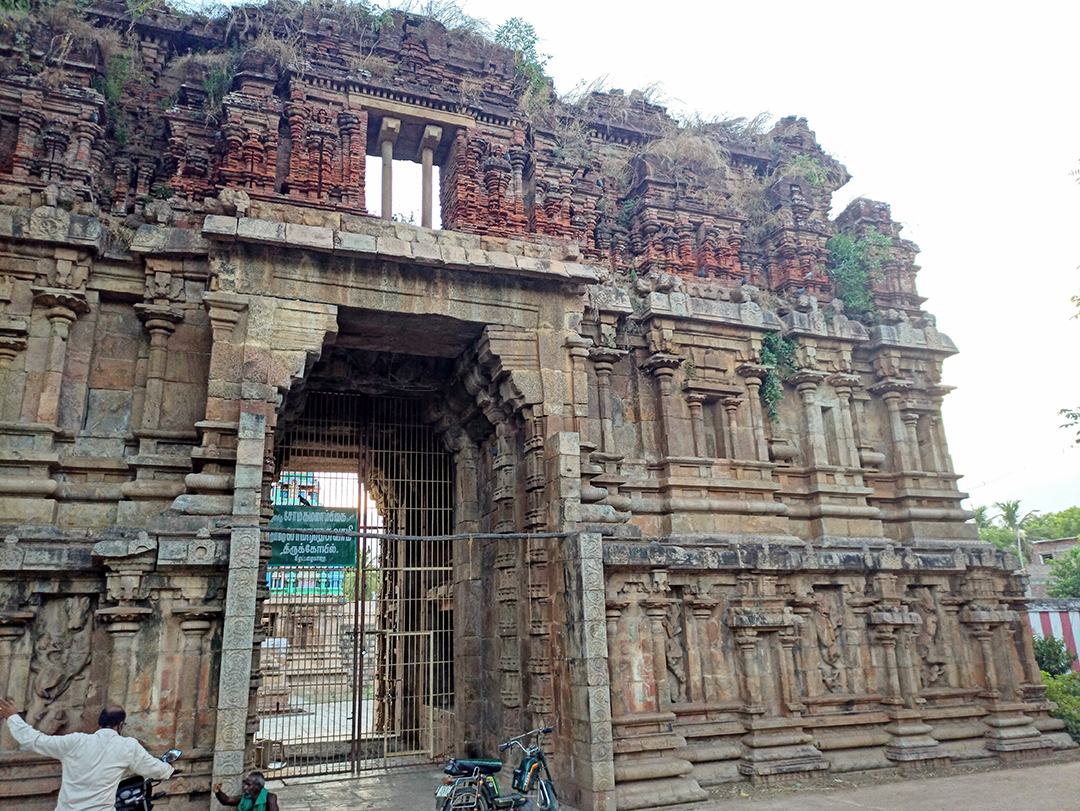
About the Temple
Pazhayarai Vadathali Sri Dharmapureeswarar Temple is an ancient Shiva temple situated at Vadathali near Pazhayarai in Thanjavur District, Tamil Nadu. The presiding deity is Sri Dharmapureeswarar, with Goddess Vimalanayaki as the consort. The temple occupies an important place in the sacred history of the ancient Pazhayarai region, one of the historically important centres of the Cholas. Pazhayarai was associated with the Chola royal establishment and was divided into four important sacred quarters — Vadathali, Metrali, Keezhthali and Thenthali. In this sacred arrangement, Vadathali represented the northern temple of the ancient city. TN Temples Project The temple is particularly famous because of its close association with Saint Tirunavukkarasar (Appar). According to the temple tradition, when Appar visited Pazhayarai, the Shiva shrine at Vadathali had been concealed. Appar refused to leave the place without seeing and worshipping the Lord and undertook a fast. The sacred history of the temple records that the Chola king was instructed in a dream to uncover the hidden shrine. The temple and the Shiva Lingam were subsequently brought back into worship. Kamakoti For this reason, Pazhayarai Vadathali is remembered as a sacred place connected with Appar's determination to restore the worship of Lord Shiva. The temple is also associated with the ancient Chola heritage of Pazhayarai and is traditionally identified as a Madakkoil. The principal shrine is dedicated to Dharmapureeswarar, while Vimalanayaki has a separate shrine. The temple is also known by names such as Vadathali, Pazhayarai Vadathali and locally Muzhaiyur / Vallalar Koil in some traditions. These names should not be confused with the nearby Pazhayarai Keezhthali temple dedicated to Someswarar.
Sthala Puranam
The most important Sthala Puranam of Pazhayarai Vadathali is associated with Saint Appar and the restoration of the hidden Shiva shrine. When Tirunavukkarasar, popularly known as Appar, arrived at Pazhayarai, he came to worship Lord Shiva at Vadathali. At that time, the shrine had been concealed and worship had been obstructed. Appar was deeply distressed on learning that the Lord's shrine had been hidden. He declared that he would not leave without seeing and worshipping the Lord and began a fast at the sacred site. His devotion and determination moved the divine grace of Lord Shiva. The Chola king Manimudi Cholan received a divine instruction in a dream revealing the location of the hidden shrine. The king came to the place and arranged for the concealed shrine and Lingam to be uncovered. The temple was restored and worship was re-established. Appar then had the darshan of Lord Dharmapureeswarar and worshipped Him with deep devotion. He sang the Tevaram hymn beginning "தலையெலாம் பறிக்குஞ் சமண்...", preserved in the Fifth Tirumurai. Shaivam records the shrine as associated with Appar's hymn and the sacred history of the temple. Shaivam This event gives Pazhayarai Vadathali a special spiritual identity: it is a temple associated with the restoration of Shiva worship through Appar's unwavering devotion. The temple's sacred tradition also connects the region with Mangayarkkarasiyar Nayanar, whose image is associated with the temple. She is one of the celebrated women devotees among the 63 Nayanmars. Shaivam The temple is also traditionally associated with Garuda and Adisesha, and the sacred tank is known as Soma Theertham.
History
Pazhayarai was an important Chola centre long before the imperial Cholas established their greatest capitals at Thanjavur and Gangaikonda Cholapuram. Historical traditions associate the region with the Chola royal establishment, military settlements and royal residences. Wikipedia The ancient city was divided into four temple quarters: - Vadathali – Northern quarter - Metrali – Western quarter - Keezhthali – Eastern / lower quarter - Thenthali – Southern quarter The word "Thali" denotes a temple or sacred shrine. The four temples formed an important sacred landscape around ancient Pazhayarai. Wikisource The present Vadathali shrine is identified with Dharmapureeswarar and Vimalanayaki. It is distinct from the nearby Pazhayarai Keezhthali Someswarar Temple, which is another historic Shiva shrine. TN Temples Project The temple's sacred history is closely linked with Tirunavukkarasar (Appar). The traditional account states that the shrine was concealed and that Appar undertook a fast until the temple was restored. The Chola ruler subsequently uncovered and restored the shrine. Appar then worshipped the Lord and sang the celebrated hymn associated with Pazhayarai Vadathali. Shaivam Pazhayarai is also associated with Mangayarkkarasiyar Nayanar and Amarneethi Nayanar, two important figures in Saiva tradition. The shrine has a traditional association with Mangayarkkarasiyar, whose image is described in the inner precinct. Shaivam The temple is therefore important not merely as an ancient building but as a monument connecting Chola history, Saiva tradition, Tevaram literature and the life of Appar.
Architecture
Pazhayarai Vadathali is traditionally identified as a Madakkoil, a type of elevated temple architecture associated with the Chola king Kochengat Cholan. The elevated character of the shrine gives it a distinctive architectural identity among the ancient Shiva temples of the region. Dharisanam The temple is comparatively compact in its present form, reflecting the changes that the ancient Pazhayarai region has undergone over centuries. Historical descriptions record the temple as having suffered deterioration, while later restoration work has helped preserve the shrine. Wikisource The sanctum houses Dharmapureeswarar in Lingam form, while Vimalanayaki has a separate shrine. The temple's architectural and sculptural tradition belongs to the Dravidian temple tradition. The elevated shrine, stone construction and traditional temple components reflect the architectural language of the Chola period. The entrance and temple structures have undergone restoration over time. The shrine's importance, however, rests not only on architectural scale but on its combination of ancient Chola heritage and sacred Saiva history. The temple's sculptures and iconographic elements include traditional Shaiva representations. Sources also record images associated with Ardhanareeswara, Dakshinamurthy, Durga, Brahma, Lingodbhava and Vinayaka in the temple complex, although the present arrangement may differ because of restoration and changes over time.
Festivals
Chithirai Brahmotsavam, Pradosham, Shivaratri
Other Deities
Vinayaka, Dakshinamurthy, Ardhanareeswara, Lingodbhava, Brahma, Durga, Chandikeswara
How to Reach
From Kumbakonam The temple can be reached from Kumbakonam through the Patteswaram – Muzhaiyur – Avoor route. Kumbakonam is the most convenient major town for visitors travelling to Pazhayarai Vadathali. Kuganarul From Darasuram Darasuram is one of the nearest railway points. The temple is approximately 3 km from Darasuram Railway Station. Autos and local transport can be used from the Darasuram / Patteeswaram side. wanderingheritager.blogspot.com From Patteeswaram The temple is very close to Patteeswaram. Visitors can travel from Patteeswaram towards Muzhaiyur and Vadathali. Local autos are available. wanderingheritager.blogspot.com By Train The nearest major railway station is Kumbakonam. Darasuram Railway Station is also close to the temple and can be used for local access. By Bus Local buses from Kumbakonam towards Avoor / Muzhaiyur / Patteeswaram can be used, followed by a short local journey to the temple. By Car From Kumbakonam, take the road towards Patteeswaram – Muzhaiyur – Avoor and follow the local directions towards Vadathali. Since the temple is in a relatively quiet village area, using the exact map location before starting the journey is advisable.